 DIY Blog
Box for Chisels: Two Steps Forward, One Step Back
08 Aug 2025I've made another box and have mixed feelings about it. In some regards it's an improvement, but in others it's actually worse than my previous work. Let's take a closer look and maybe draw some conclusions.
Wood
Unlike my previous boxes that were made from recycled drawer parts, this one actually originated as the same sweet cherry board I used to make the router a while ago. Now that I have access to a bandsaw, resawing this board in half was a breeze. Unfortunately, the half-thick boards warped quickly and it took quite a lot to flatten them.
Same as before, the box had two panels that were glued up from narrower boards, except this time the bottom was also a panel, not a sheet of plywood. The glueups felt like a constant struggle though. I should have put more effort into flattening the boards, making sure they were jointed square, and should have used cauls during glueup. I still managed to get a good joint between the boards on the show surface, but the panel cupped badly. All the time saved flattening the original boards had to be paid back with interest by flattening the resulting panel.
Construction
The way the panel interfaced with the sides of the box was also slightly different. The sides were built with a groove and the panel with a tongue. I cheated on the grooves and made them with an electric palm router. As for the tongue, or the rabbet, depending on how you view it, I make it with a shoulder plane and overshot the dimension. Lack of flatness and inconsistent thickness of the panel didn't help either, so this joint turned out sloppy. At this stage, I could only hope for the strength of my clamps and the gap-filling power of my polyurethane glue.
I managed to get the rabbets in the sides of the box to be spot on and square, so that part glued really well. I did not leave the panel floating, instead choosing to glue it in. The glue did fill all the gaps, so at least the box turned out mechanically solid. After a quick cleanup with a smoothing plane the box was ready to be cut open.
Inside the Box
Cutting the box open with a bandsaw felt like a good idea at the time. And it would have been a good idea, had the bandsaw blade not been packed with caked sawdust. The blade deflected quite a bit, and I honestly would have made a straighter cut by hand. But after some planing and sanding I managed to get the box to close without a gap. I've probably lost a whole centimeter of box height in the process, but I had plenty to spare, fortunately.
As the panel joints were pretty gappy, I did not skimp on the glue. As a result, there was a lot of dry glue inside the box when I cut it open. I did get it out with chisels and scrapers, but that made the surfaces rough and not nearly as pretty as the outside of the box that I was able to plane.
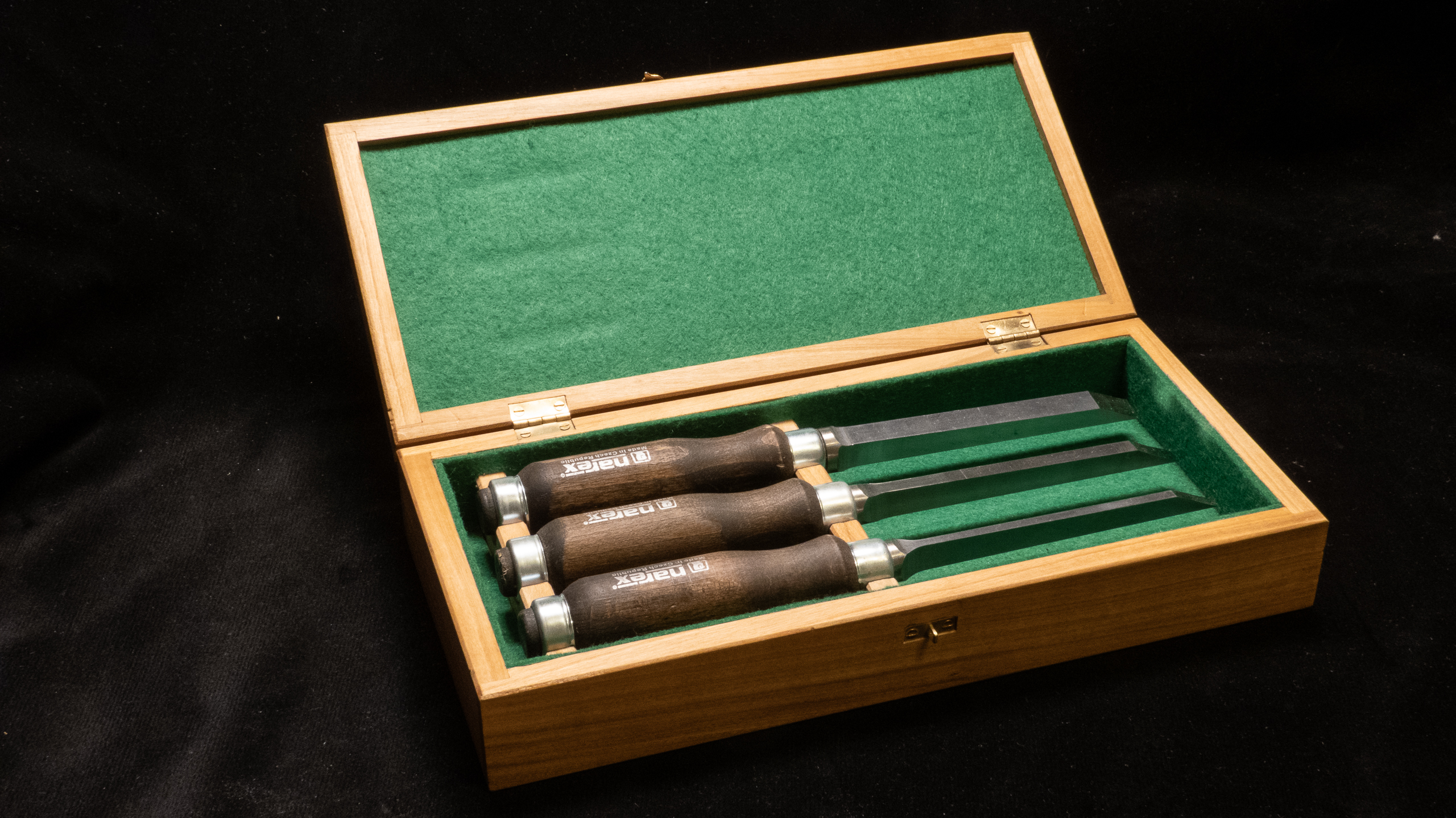
After removing the glue I added the supports for the chisels and I must say this was a great idea, as it forced the chisels to sit firmly and not rattle around in the box.
Lining
The synthetic felt material worked well enough to conceal the ugly inside corners with their gaps and residual glue squeezeout. Applying the contact cement around the supports for the chisels proved to be much harder than with the previous box, and I am no longer so sure contact cement is the best choice for this application. Maybe I should not attempt to cover the whole surface and instead focus on the perimeter only. Or perhaps I need a toothed spatula used in tilework to spread the glue more evenly, or maybe I need to thin the glue a little bit with mineral spirits.
One unexpected and pleasant surprise was that with the lid closed the upper lining would sit on the chisels and even compress a little. Because of this the chisels fit snugly and do not rattle even when the box is turned upside down.
Hardware
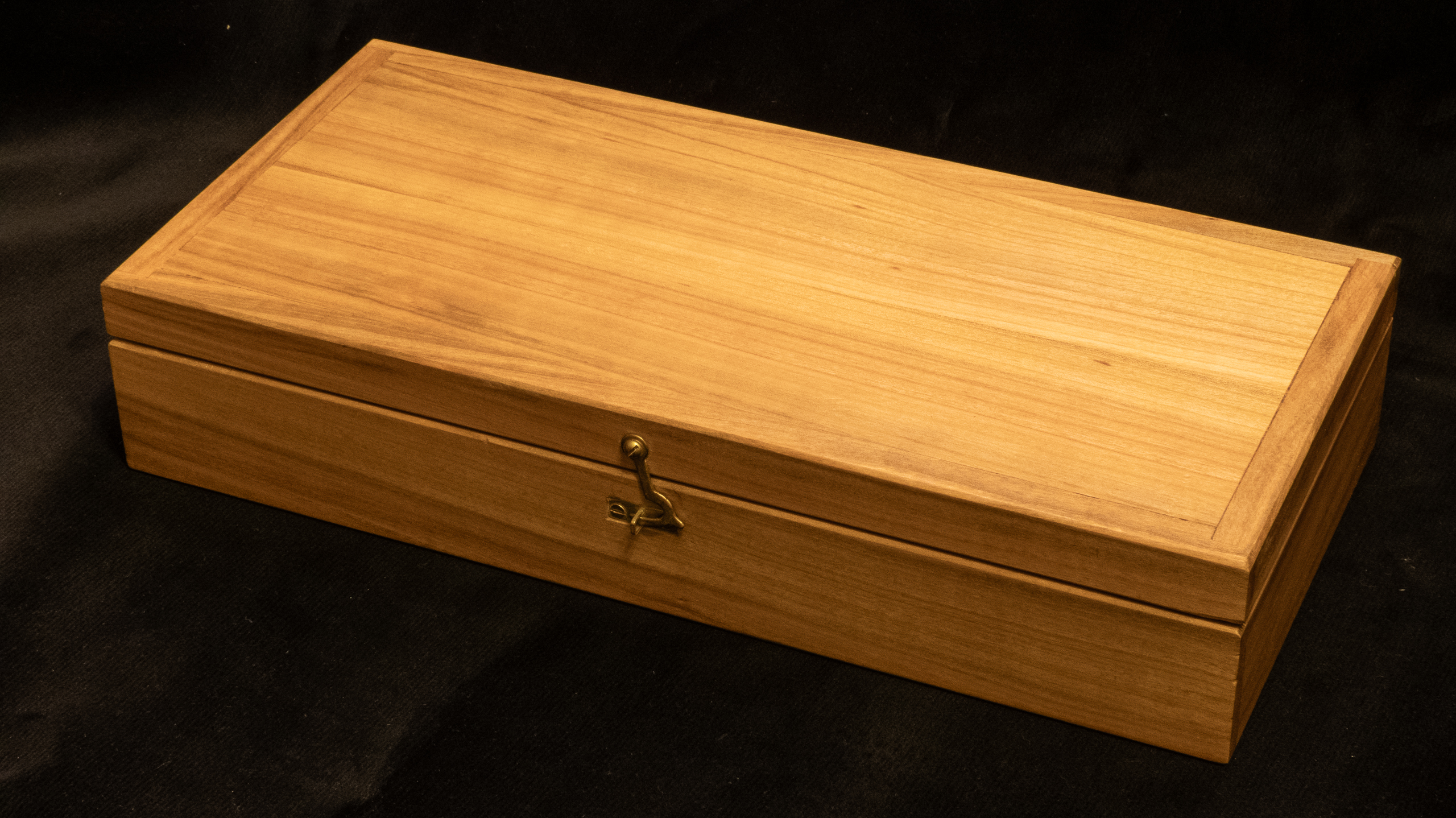
Last time I enlarged the countersinks in the hinges to help the screws sit flush with the hinge. Turns out it wasn't necessary, or at least I did not need to make the countersinks so deep. There is a gap there when the hinge is fully closed, and it is large enough to accomodate the screws even if the sit above the surface. The hook works well enough, and with the wood slightly thicker than in my previous box, I did not have to shorten the screws to make them fit.
Finish
A layer of oil-varnish blend and another layer of diluted varnish was all it took to get to this point. I sanded the varnish a little bit to knock down dust and other irregularities. The varnish layer turned out to be pretty thin, so I might add another layer in the future. I definitely need a better brush for the varnish, as forgiving as it is, or try spraying it on. But here is the final result.