 DIY Blog
Winding Sticks
21 Oct 2024Making a set of winding sticks is a rite of passage for aspiring woodworkers. The process is fairly simple, and in the end, you create a useful tool. The sticks can be made with varying degrees of fanciness, and mine are quite plain. I will take the opportunity to focus on the finer details and reflect on the lessons learned, despite the apparent simplicity of this project.
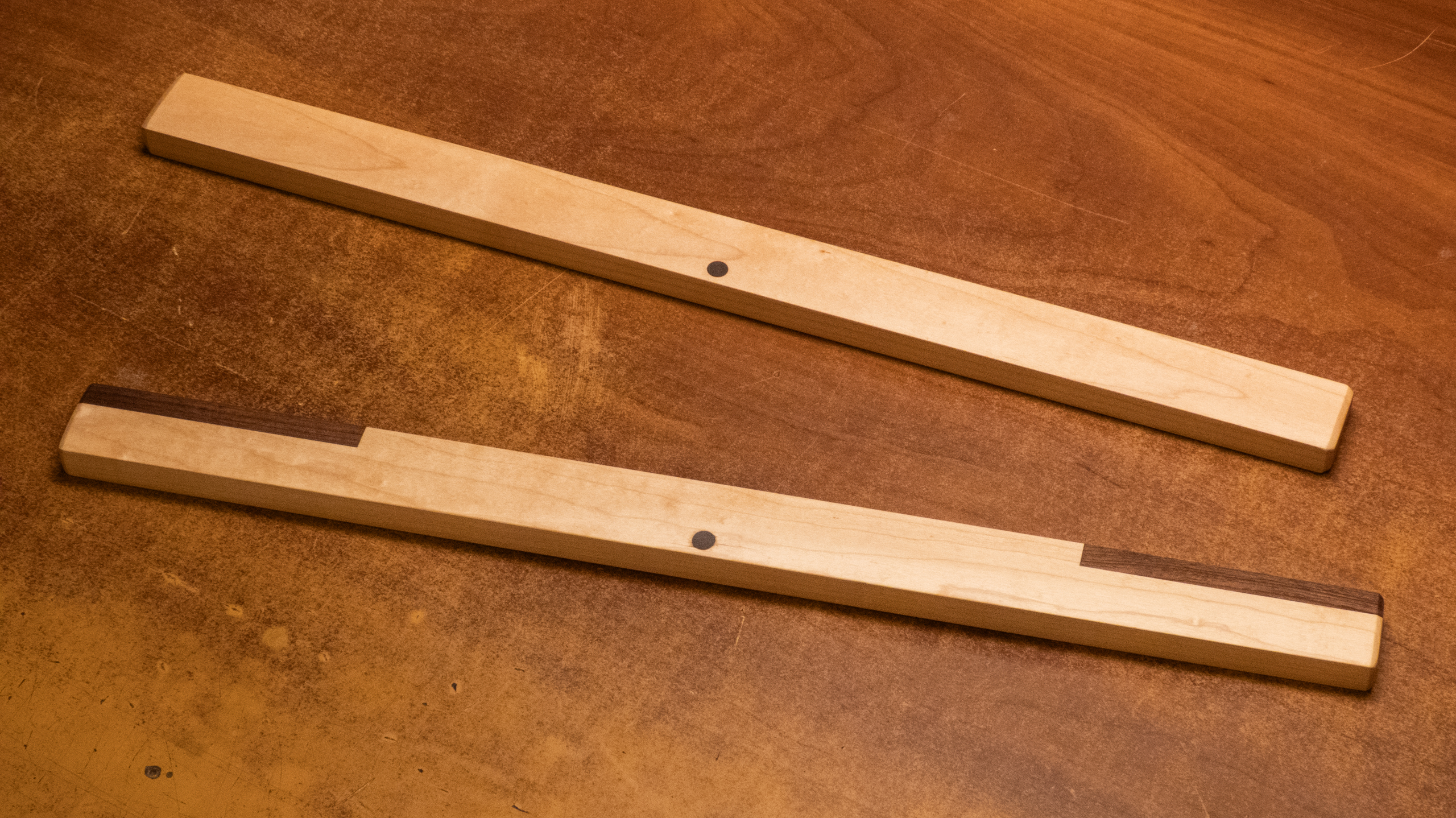
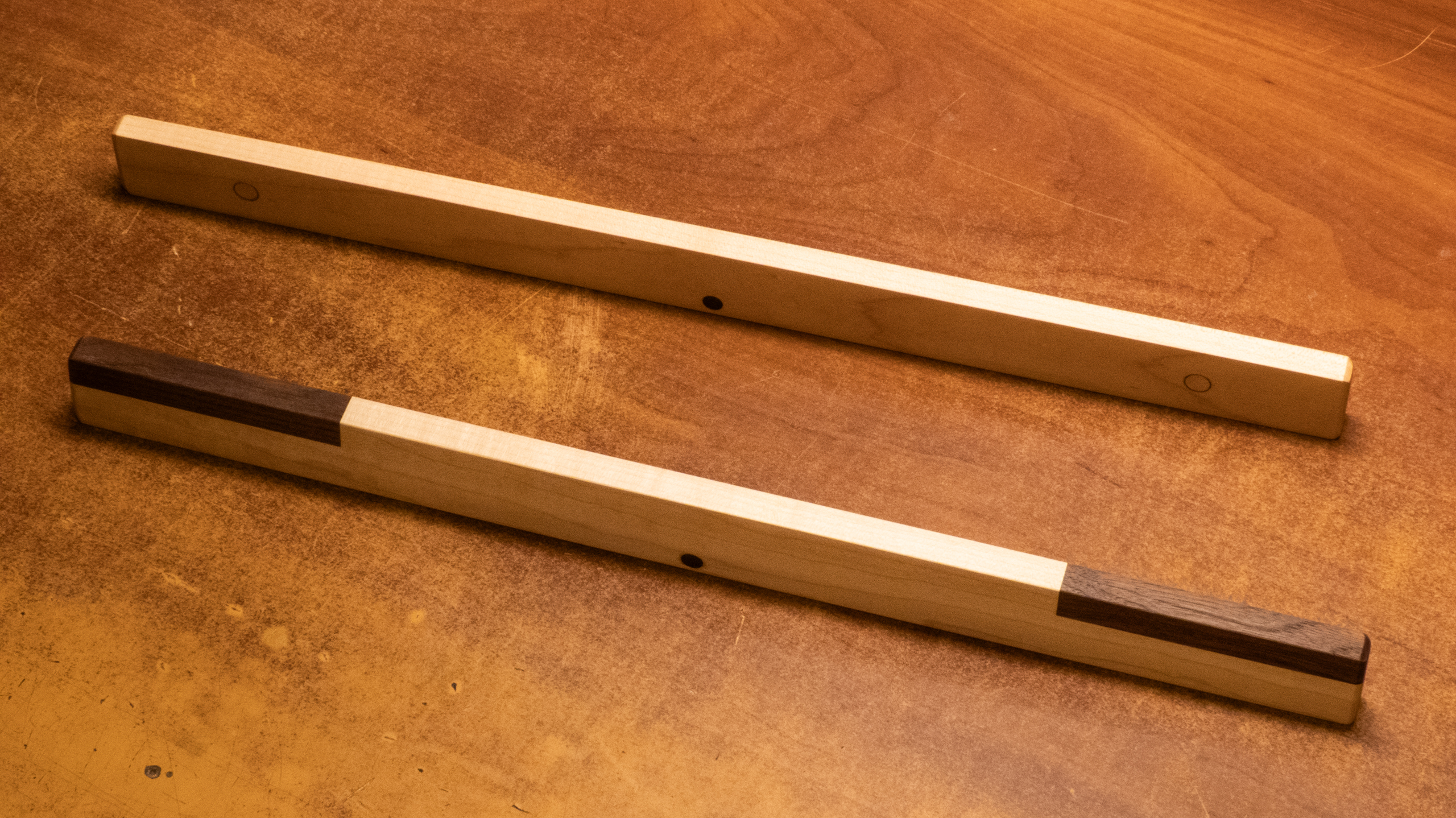
My winding sticks are made of maple. This wood is almost white with an unobtrusive grain pattern, relatively hard, resistant to chipping, and planes nicely. The accents are made of walnut, mainly for contrast. Against the maple, the walnut stands out really well. Without access to exotic woods like ebony, these two woods offer the best contrast.
Planing the thin stock
The first step, of course, was stock preparation. Fortunately, I had a few maple strips already milled to about the right dimensions. Unfortunately, planing them flat proved quite a challenge. I blame my flexing workbench and, to some extent, poor planing technique.
My current workbench is an old office table made of particle board. It turns out it's sagging under its weight, even more so when downward pressure is applied. This isn't a big deal with thick boards, but when planing thin strips, the middle ends up oversized while the ends are undersized.
In the end, I was able to overcome this with a light touch and some shims under the middle of the board. At least the final dimensions weren't critical, as long as the bottom edge and the magnet face were flat and square to one another.
Lesson learned: thin stock is very hard to plane without a flat, rigid work surface.
One thing I might try in the future is holding the strips in a vice while planing. This should solve the flex issue, and with proper technique, the boards should come out flat.
Making the walnut inlay
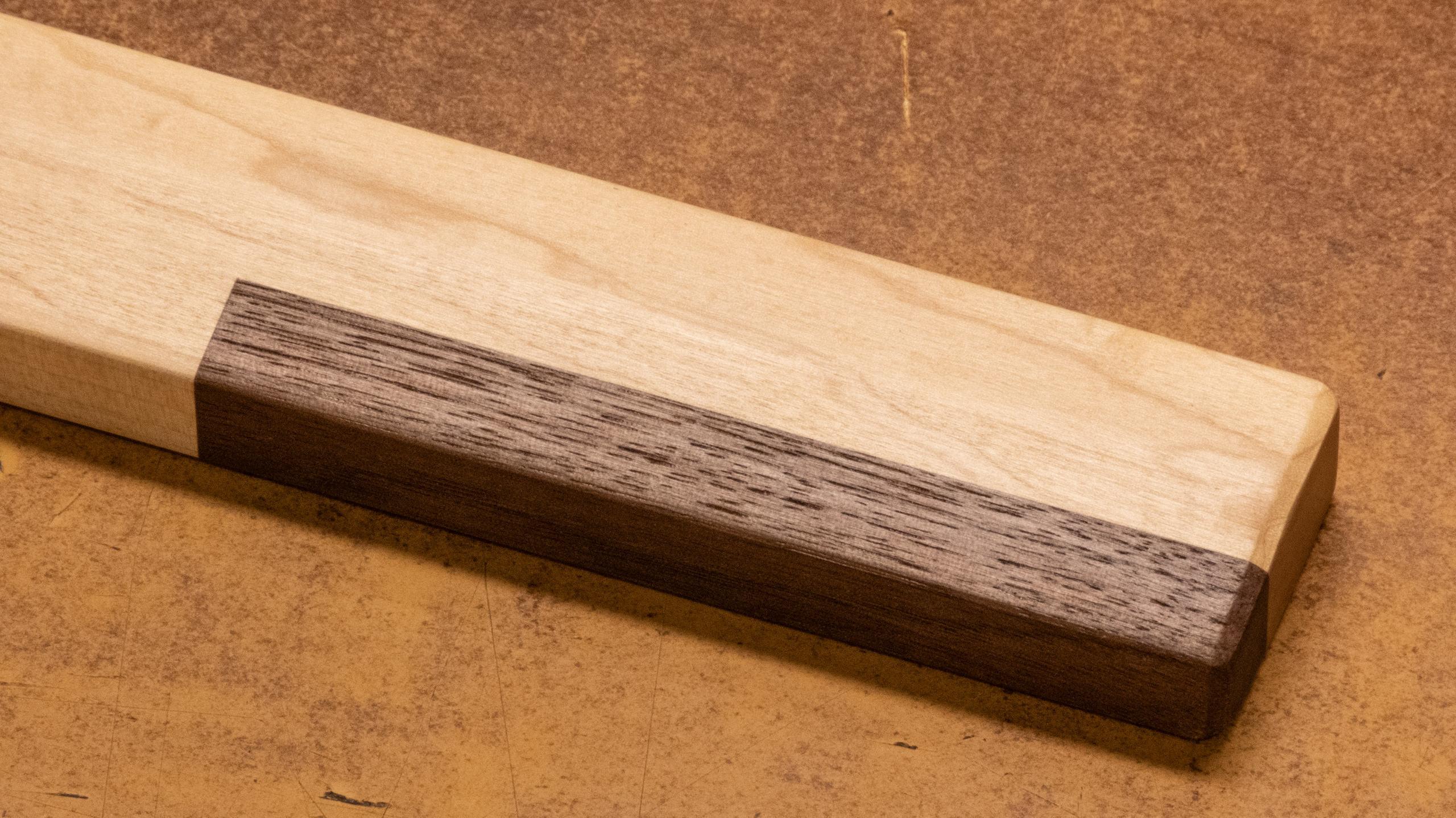
If I'm proud of any one part of the project, it's the inlay. Making the walnut piece was trivial — just planing it flat and trimming it square on a shooting board. The corresponding notch in the maple, however, was much more challenging. I did the rough cut with a saw and even tried planing the bottom face with a chisel plane but without much success. Then I realized I could place the board on a flat surface, use 1-2-3 blocks as spacers or supports, and flatten the bottom face with a router plane.
The fit was perfect, but I still used polyurethane glue, known for its gap-filling power, and a ton of clamping pressure. The protruding excess wood was planed flush, and I was amazed to see no gaps at all.
A router plane is the perfect tool for creating a flat bottom in a recess, but it's tricky to use on small, thin boards. But I can construct a jig with 1-2-3 blocks for the router plane to ride on.
Adding walnut plugs
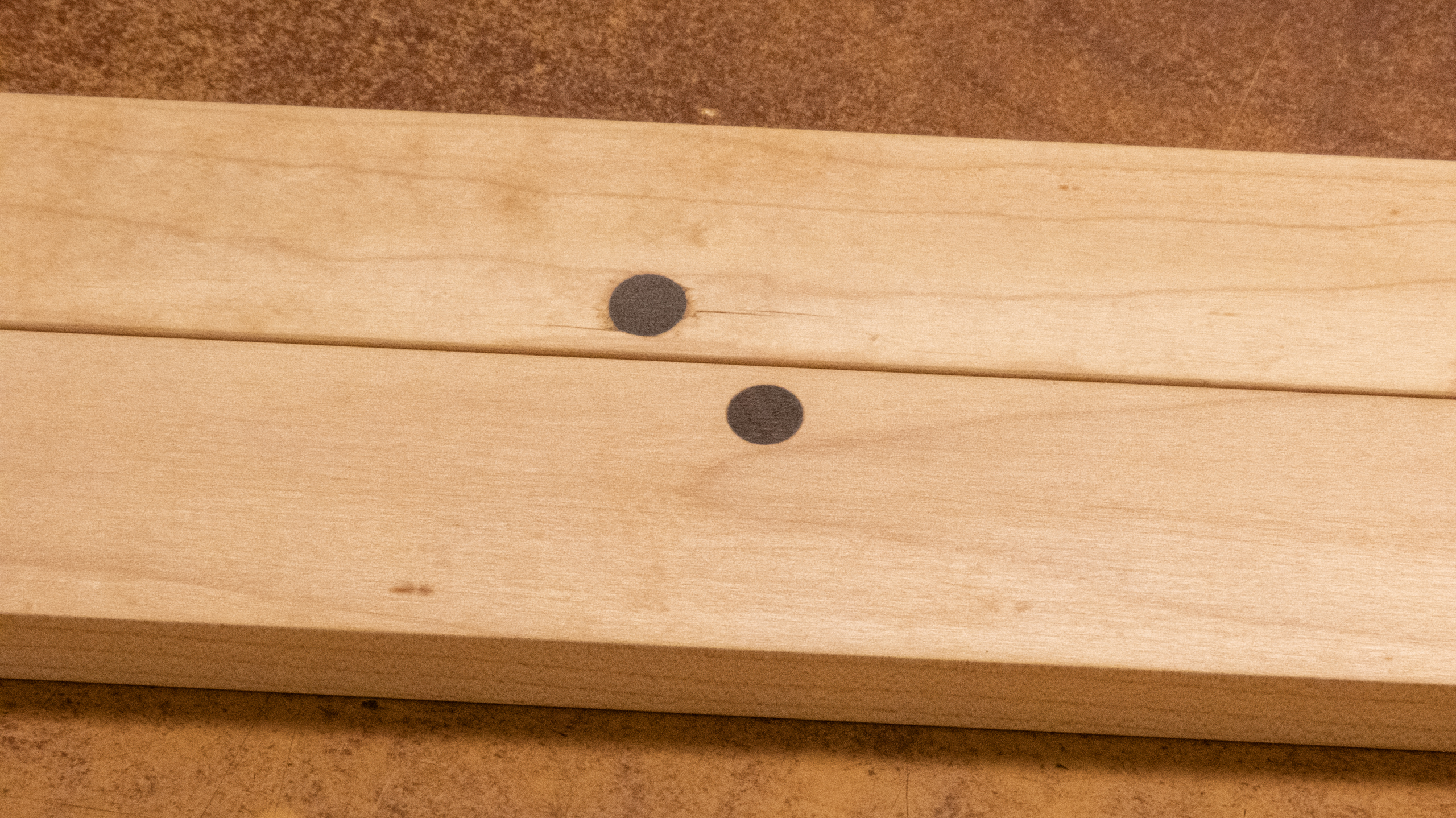
Let's just say these plugs were another learning opportunity. The plugs themselves weren't hard to make. I took a roughly cut walnut stick and ran it through an M10 tapping die, then sanded it down a bit. Thus were made two short and slightly oversized 8 mm dowels. But it was the drilling that got me.
Let the first plug be known as the Plug of Shame. For some reason, I thought drilling a small hole and then enlarging it with a bigger bit — a standard metalworking move — was a good idea. It wasn't, especially not with a hand drill. I mangled the hole. To make matters worse, I drove the slightly oversized dowel all the way in and cracked the wood.
The second plug is my triumph: hole drilled out with a proper woodworking drill bit on a drill press, walnut sanded to fit perfectly. To state the obvious, I have only one reliable way to make crisp holes in wood: using the drill press and a sharp brad point bit. Anything else is just asking for trouble.
The magnets
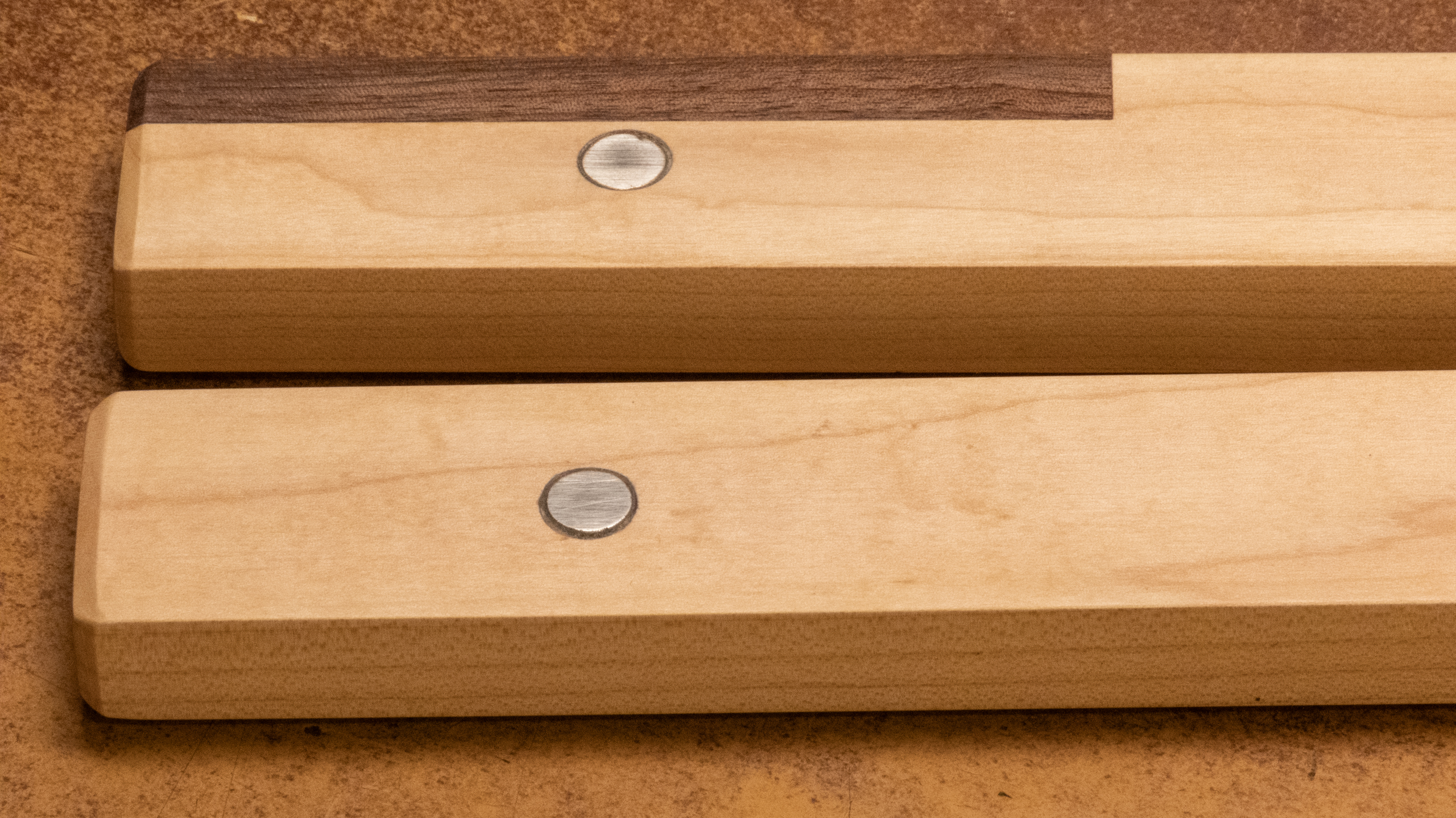
This project made me see neodymium magnets in a new light. First, they are not as strong as I thought they would be. I chose 10 mm magnetic discs because the largest brad point bit I had was 10 mm. The magnets hold the sticks together, but just barely — and that's with two pairs of magnets.
Second, they are very tricky to position correctly. Since I was pairing the magnets together, they needed to line up exactly. I was almost able to do that, but in the end had to make oversized holes and add more epoxy glue to fill the gaps. If I were to do this again, I would set up stops at the drill press for more repeatable drilling.
Finally, unlike wooden plugs, magnets can not be sanded flush. The shiny nickel plating gives way to brittle black neodymium. Therefore all surface preparation must be done first, and the magnets are glued in at the very last moment. They can not be proud of the surface, but they also can not be recessed, as any gap will weaken the magnetic link significantly. Luckily, I stopped sanding at the first sight of scratches on the nickel, and the magnets sit perfectly flush.
The finish
The perfect finish still eludes me. I like to use a penetrating oil-varnish blend as the first, and sometimes second, layer. The oil enhances the wood's color and texture, but it's not particularly protective, so I turn to polyurethane. Once again, I've diluted the polyurethane with mineral spirits and applied multiple wiped-on coats. The result is acceptable, but far from perfect. I just can't seem to get a uniform coat of varnish — either it's too thin, or there's too much.
Perhaps it's time to try hardwax oil finishes, especially the two-component variety. Either that, or I need to invest in a spray gun and set up an improvised spraying booth, though that's its own can of worms.
These winding sticks are simple, but still a few steps above the bare minimum, which would be just two equally sized strips of wood. The inlay provides better contrast and helps one stick stand out against the other. The dot in the middle makes it easier to center the sticks on the board. The bevel detail makes it obvious which sides are parallel. The magnets help store the sticks as a single unit. And chamfers? Well, chamfers are what separates us from the animals, indeed.