 DIY Blog
Bulding Handscrew Clamps
26 May 2023I built this handscrew clamp from a kit that I recently purchased. The kit included all the metal hardware and birch handles, requiring only the construction of the clamp bodies from wood.
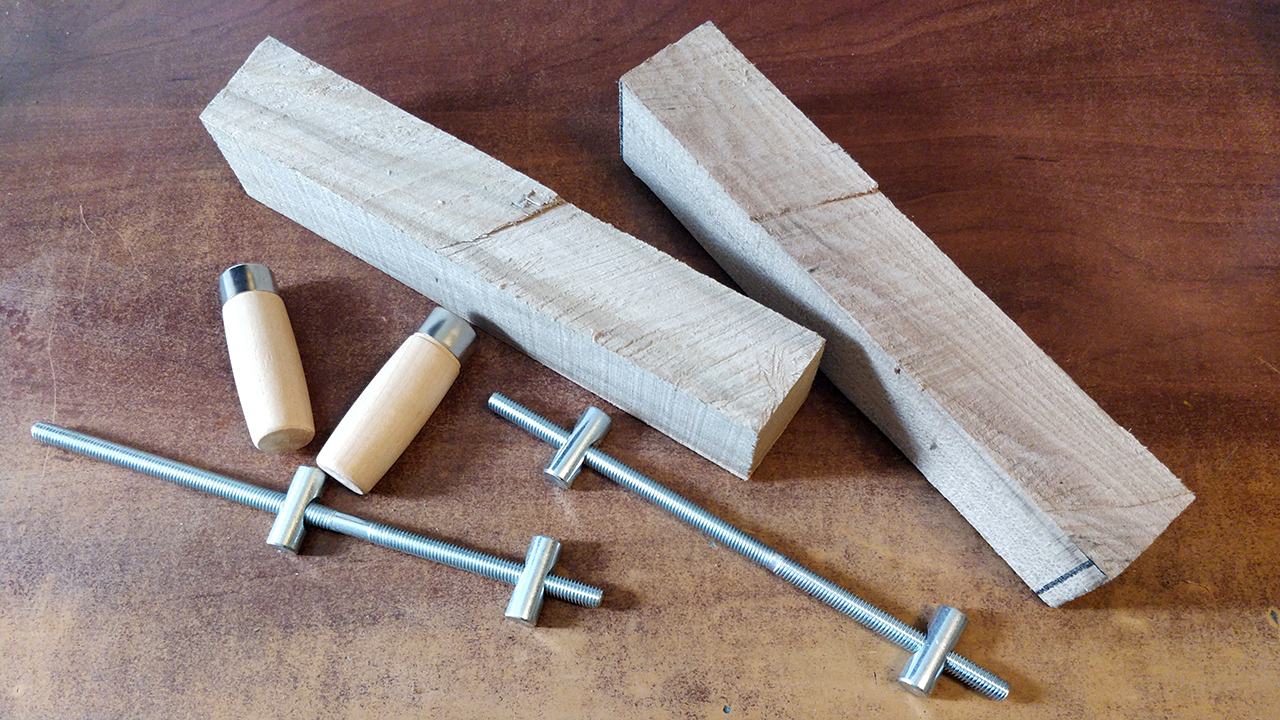
Initially, I intended to build the clamps using maple, but my wood supplier didn't have thick maple boards. I didn't want to glue together thinner stock, so I opted for this lovely, straight-grained elm instead.
The kit came with instructions to square the stock and trim it to specific dimensions. However, the clamp should still function properly if both halves are identical, even if the exact dimensions are slightly off.
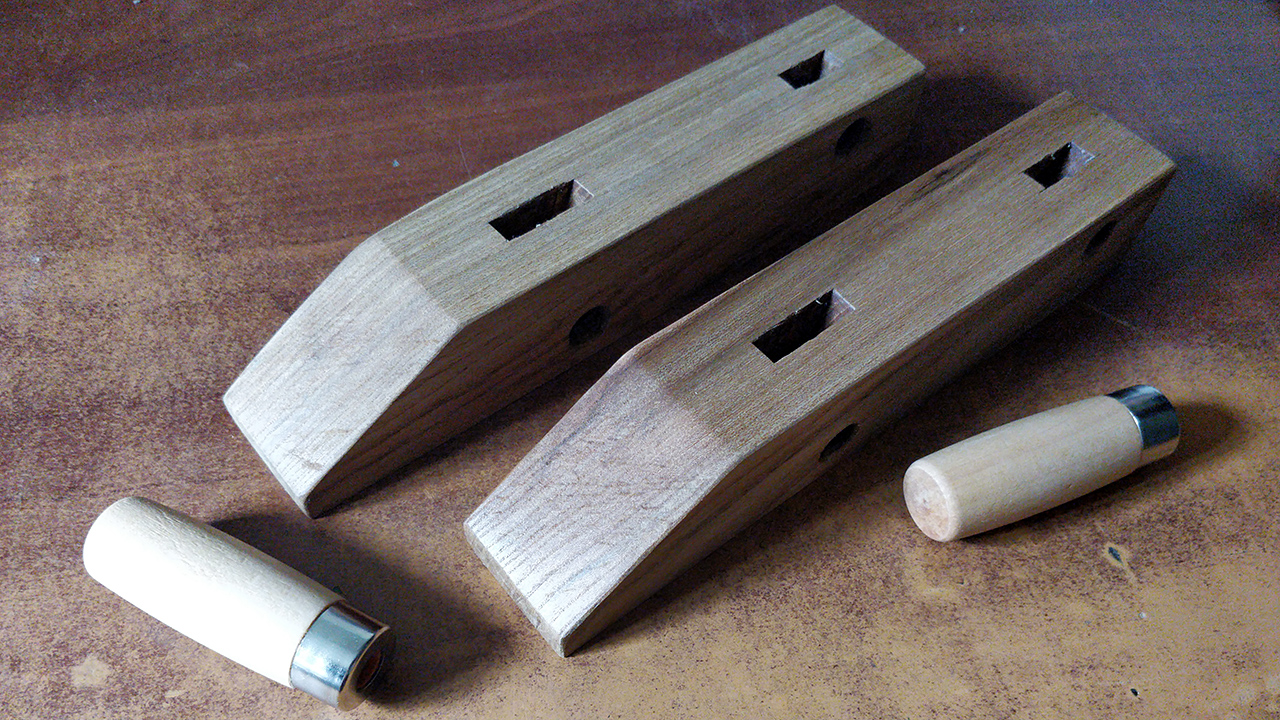
The plans called for straight cylindrical holes for the barrel nuts, as well as v-shaped slots to accommodate the threaded rods. I marked out the holes for the barrel nuts and drilled them from both sides to ensure they were perfectly square to the sides.
As for the v-shaped slots, I initially attempted to make them with a drill, but that method didn't work out. I struggled to drill precise angled holes using a handheld drill. In the end, I successfully chopped these slots out with a mortising chisel.

The plans recommended an oil or wiping varnish finish. I sanded the pieces up to 240 grit and applied my usual oil-varnish blend finish, which turned out quite well.
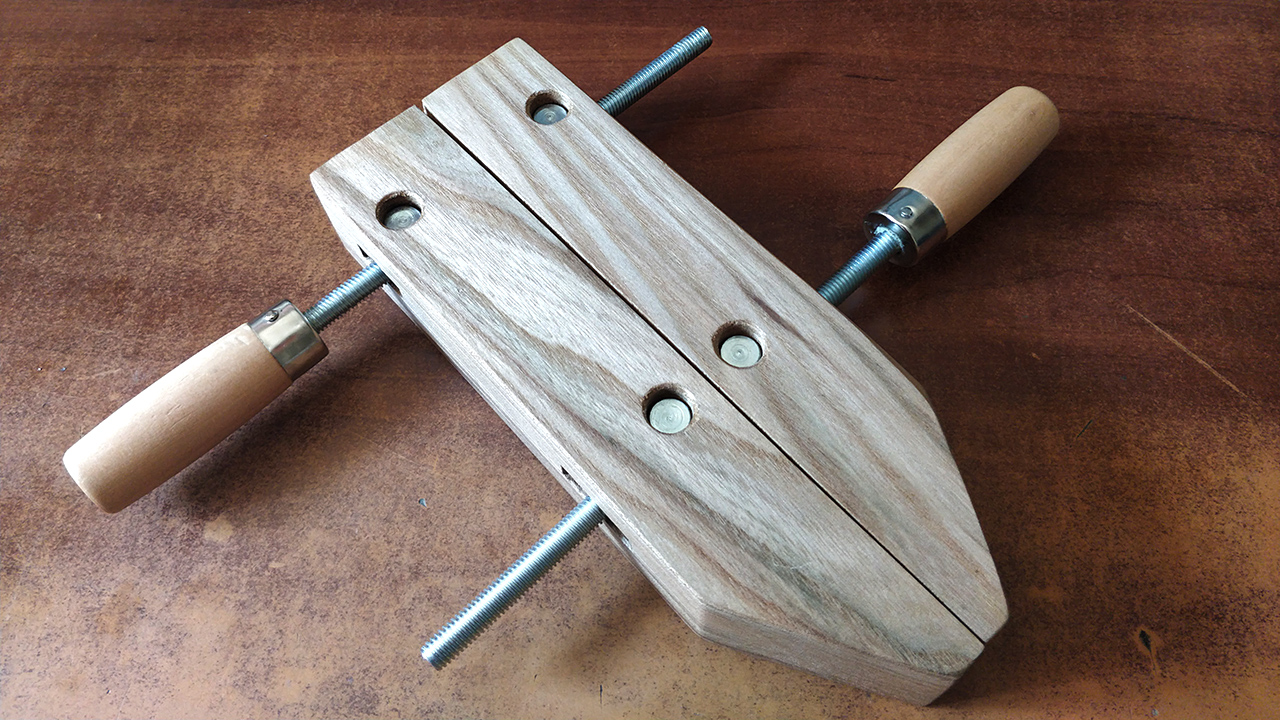
Assembling the clamp proved to be tricky. The handles could only be attached after the rods were threaded into the barrel nuts. This meant that once the handles were attached, the clamp couldn't be disassembled. I decided to permanently attach the handles and deviated from the plans that recommended epoxy, opting for polyurethane glue instead.
Unfortunately, I applied too much glue, which expanded and dripped onto the exposed threads. I should have protected the threads with masking tape. The glue itself might not be as strong as epoxy, but it's much easier to work with.
The kit also included rivets, which I used. Although the clamps probably would have functioned well without the rivets, it was a good opportunity for me to try a new technique.
Riveting didn't go as smoothly as I had hoped. Drilling without a drill press resulted in slightly oversized holes, causing the rivets to fit loosely. Peening the end of the rivets could have been better too. I need more practice in this area, and I also need a sturdy anvil. For now, I'll steer clear of this operation.
What could have gone better? After all, I have another kit and another clamp to make.
- I should have used my mortising chisel from the beginning for the v-slots. Having some kind of jig to guide it at an angle would be helpful since this time I did it freehand.
- There is such a thing as too much glue. Managing the squeeze-out can be challenging, so next time I'll either use less glue or mask the adjacent surfaces.
- The rivets are not truly necessary, so I could omit them altogether.
- For the hole housing the barrel nuts, I could try drilling it slightly undersized first, and then enlarge it with a larger drill. This might improve the fit, but I should test it on a piece of scrap wood first.
Undeniably, the clamp works and is surprisingly strong for its size. However, the wood itself isn't particularly hard. I've noticed it compressing under pressure, but this may actually be a desirable feature.