 DIY Blog
Bevel Gauge
27 Apr 2023The finished bevel gauge is both beautiful and functional, boasting a polished brass and black walnut look that can't be beat. The build process was relatively simple, with only a few minor snags along the way, but more on that below.

I chose to purchase this kit for convenience, as it included all of the necessary brass parts and hardware. However, the blade could be made from an old saw and the brass parts could be cut from sheet brass of the correct thickness. The carriage bolt and the knurled nut are commonly available too. The only challenging aspect would have been filing out the long slot in the blade if I had decided to make it from scratch.
While the brass parts included in the kit were adequate, they were not perfectly flat due to being cut out of sheet stock using a die press. However, with some sanding and filing, they were easily made flat. The knurled knob certainly functioned well, as did the carriage bolt. I was mildly disappointed that the bolt was not actually made from brass – it was clearly coated steel which became evident as I tried to file the bolt to better fit the brass parts. At least the nut does not react to a magnet, so it is probably made from some copper alloy.
The kit did not include any wood, so without access to rosewood or ebony or other exotics I decided to use black walnut. The contrast between dark woods, especially when oiled, and polished brass is simply stunning.
With a little bit of research, I've discovered two designs of bevel gauges. One design was based on a thin saw kerf cut in a solid piece of wood, and the other used a brass shim laminated between two pieces of wood. I chose to use the laminated construction method since I was not confident in my ability to cut a long straight saw kerf. I used brass of the same thickness as the blade for the shim.
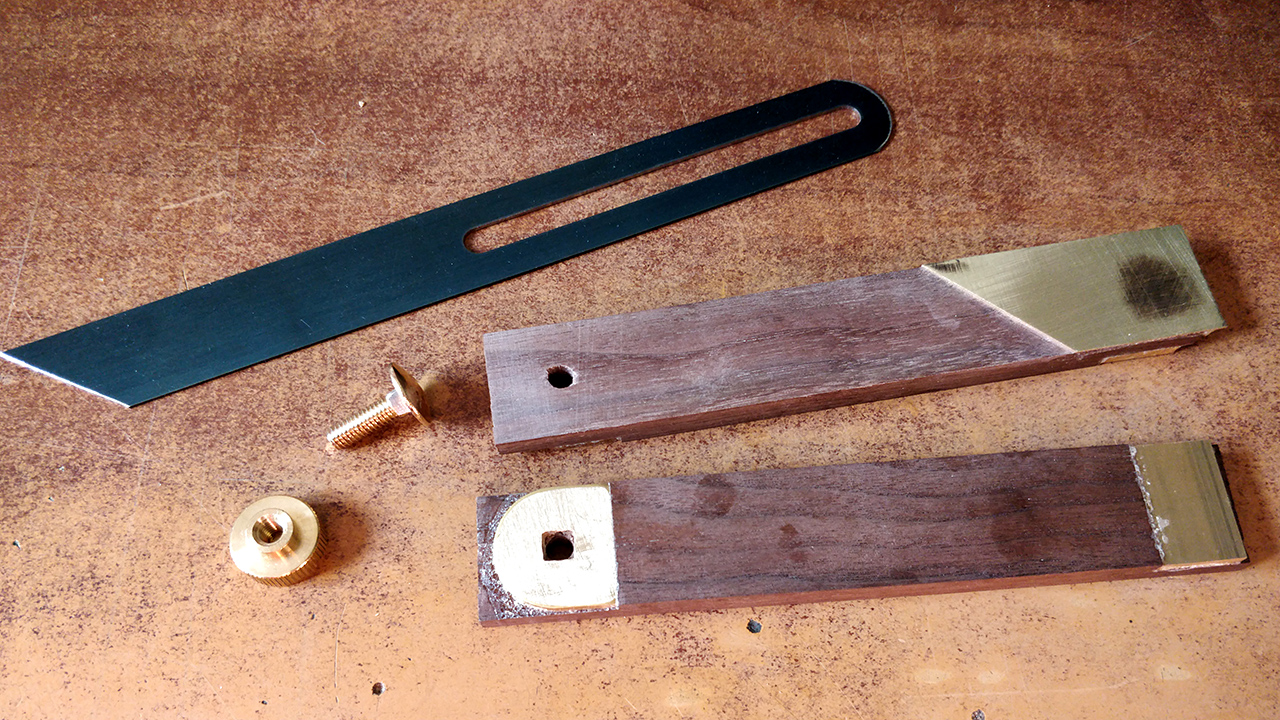
After planing the walnut strips to a reasonable thickness, I made recesses for the brass parts and glued everything together in stages using polyurethane glue. I found polyurethane glue to be easy to work with and effective at filling voids, and it cured fully in only four hours. It was certainly much easier to work with than epoxy which was the one other alternative I had been considering.
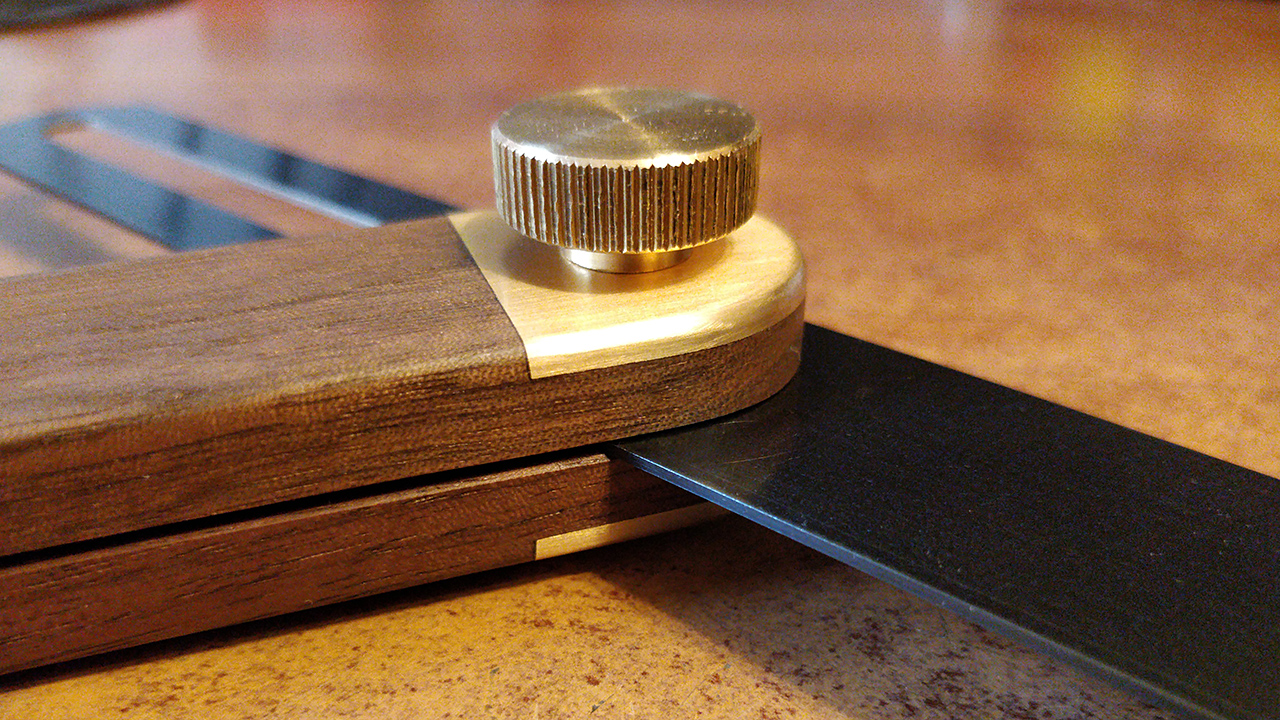
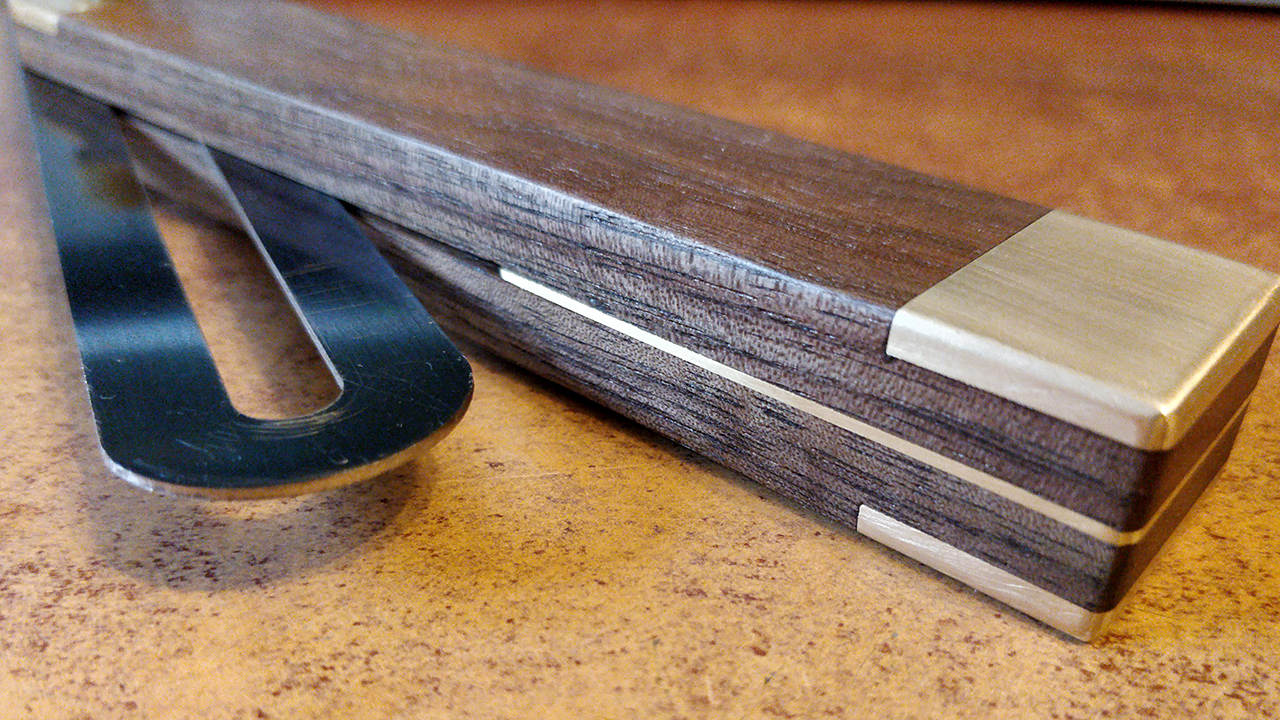
Once the glueup was complete, I sanded all surfaces flush. As much as I'd like planing to be the finishing step (at least for the bragging rights, if not for any practical reason), I had to use sanding because of the inlaid brass elements.
When it came to sanding the mostly flat surfaces, I employed a technique that I typically use when flattening plane iron and chisel backs. I permanently attached sheets of sandpaper to recycled particle boards to sand the bevel gauge body against. I find this method to be more practical than temporarily affixing sandpaper to glass or other flat surfaces. Since the particle boards came from recycled shelves, they are disposable. Once the sandpaper wears out (which can take a while with good quality sandpaper), the boards can be easily discarded.
The sanding process was straightforward. I started with a coarse grit of 80 and gradually worked my way up to a fine grit of 240. After that, I hand-sanded with even finer grits of 320 and 500. To ensure a clean surface between sandings, I wiped off the dust with alcohol.
Then I applied two coats of oil-varnish blend with a day between coats. Now finished, the bevel gauge looks beautiful, although it smells like varnish for the time being. Over the next month or two, the varnish smell will dissipate and the natural walnut smell will return. At least that happened to my plane handles which now have the wonderful and unmistakable smell of rosewood.

So far I have not yet decided what to do about the blade, I might eventually sand off the factory blue finish and polish it until it shines. But for now, the blue finish stays.
Overall, this was a pleasant project and I really like the result. I actually bought two kits, so I will definitely make another bevel gauge from the remaining parts. While I don't necessarily have a use for two bevel gauges, their beauty alone is reason enough for me to make them.