 DIY Blog
Painting Planes
12 Jun 2022When I get my hands on old tools, I generally try to repaint them. I like the consistent look. There's nothing unusual or fancy about painting your hand planes black, but I like how matte black contrasts with wood shavings and polished metal. Besides, what better way to learn the tools than to fully disassemble them and then put them back together?
Preparations
Whenever possible, I go for the full disassembly. Some parts are riveted on, so I have to take out the rivets. Generally, there are rivets in lever caps of block planes and in lateral adjustment levers on frogs of bench planes.
Whenever old screws are stuck, I use WD-40 and heat. Heat can damage the paint, but it does not matter as the surfaces will get repainted anyway.
My preferred method to strip the old paint is sandblasting. I like it better than the chemical paint remover because it also gets rid of rust and roughens the surface slightly. Paint sticks so much better when the surface is rough.
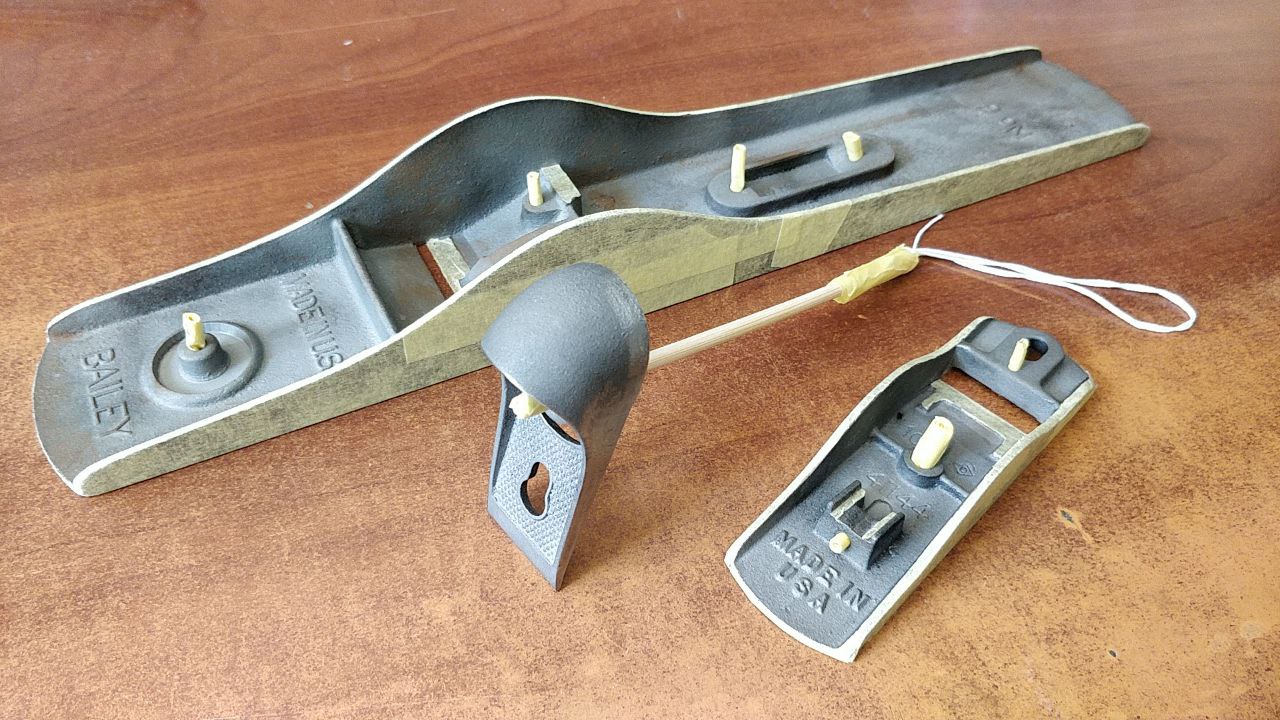
Factories' efforts on cleaning up the castings are minimal. They rarely remove all flashing. Often they just cut off gates and risers without blending in the cut. So after the sandblasting I usually do some filing and sanding to remove the most obvious defects. I then apply masking tape. Oddly-shaped parts receive contraptions that allow me to suspend them while painting.
All threaded holes are plugged with rolls of masking tape to avoid filling them with paint. Without matching taps (often quite rare and exotic) it would be very hard to clear those threads.
The Rims
I am very particular in regards to which surfaces must be covered with paint and which must be left bare.
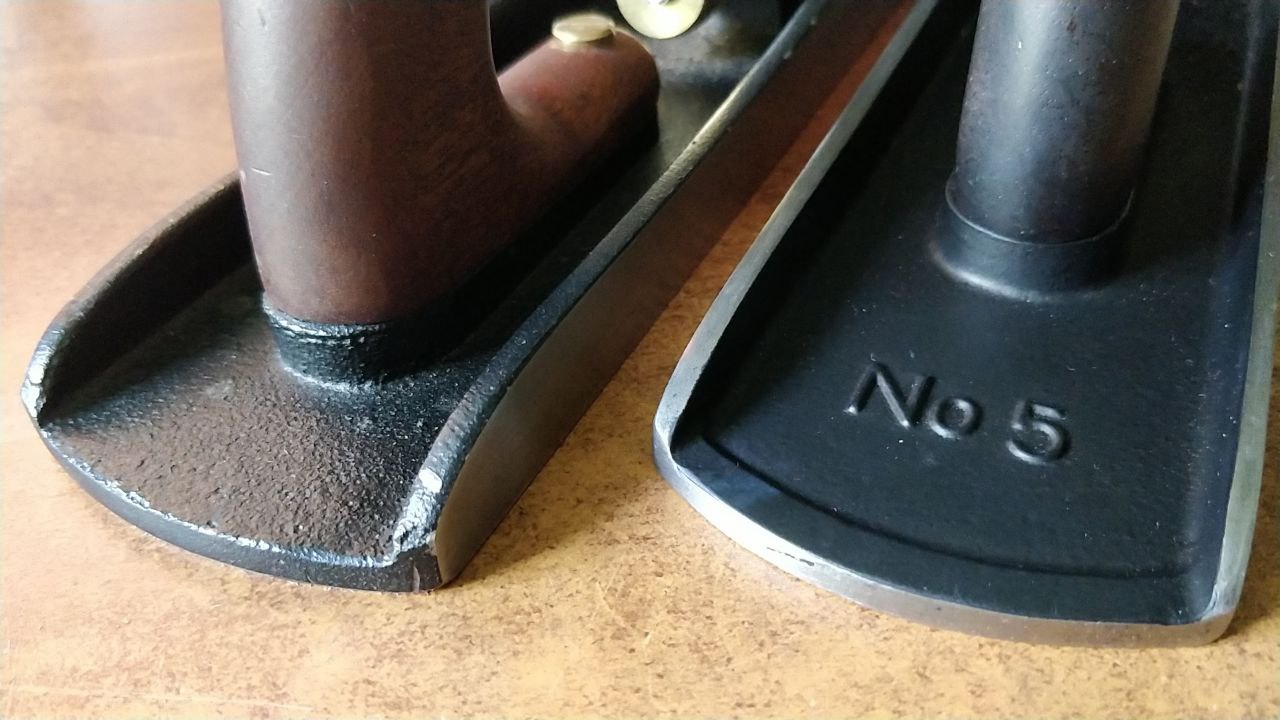
On the left is a modern Axminster low-angle jack plane, and on the right is a restored Stanley #5. It is obviously easier to just paint the rims as they do it now, but I really like the contrasting look of the original Stanley. It's hard to mask the rims effectively, but to me, it is worth the effort.
The Paint
I use a chemical degreaser before painting. It's just some strong solvent in a spray can that I apply liberally, effectively rinsing the part with it. Then it's on to painting.
My planes usually get three coats of acrylic primer followed by three coats of alkyd enamel. The primer fills small pores, dries really fast, and adheres to metal perfectly. The enamel is smellier, takes longer to dry, and even longer to harden, but once fully hardened it is as good as any modern factory paint.
I don't have tons of things to paint, nor a painting booth, so my paints come in spray cans and I do the painting outside when the weather is warm, dry, and calm. Summer is probably the best season for spray painting outside, as long as there is no wind. The paint dries quickly.
Post-processing
The next day after painting, once the last coat is dry but not fully hardened, I use sandpaper to remove the paint that may have seeped under the mask. My masking tape does not stick too well to the rims, and even if it does, the degreaser may cause it to peel off a little bit. So there are places where excess paint needs to be removed.

Thankfully, both the primer and the paint are black. That is why sanding works so well. Were the primer gray or white, it would have been visible where the paint ends and the bare metal begins. I use some fine sandpaper, and once I'm happy with the look, I set the parts aside for a week or two for the paint to fully cure and harden.

Who am I kidding? I have no patience to just shelve everything for two weeks! Of course, I try to put the tool together the next day, and of course, I nick the paint, and of course, I am not in the least ashamed of it.